Common fault
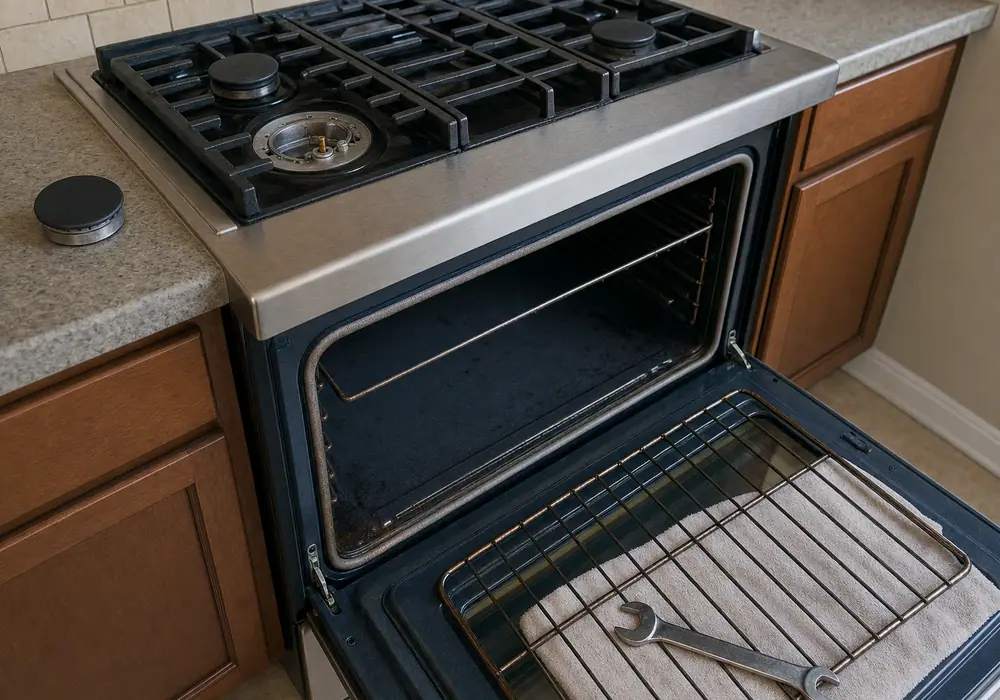
Why is my oven not heating properly?
Short answer
An oven called dead is usually still working, just to the wrong number: the sensor drifts, the control trusts it, so you get uneven browning and roasts wanting another half hour. Say so when you call Poway Sub-Zero Repair Experts on (858) 630-4145.
Why we start there
No heat at all is cheaper — a glow bar too weak to open the valve, or a bake element.
What happens next
The propane question is not a formality. An appliance built for natural gas has to be converted to run on LP, which means the correct orifices and the regulator set for the right pressure, and a conversion done incompletely or reversed years later during a move produces symptoms that look exactly like a failing burner: lazy yellow flame, slow preheat, a broiler that will not hold, or an oven that lights fine on a mild day and struggles on a cold morning. That last one has a physical reason behind it. A propane tank that is cold and low delivers less vapor pressure, so the appliance at the end of the line is genuinely being underfed, and no part inside the range will fix it. If you are on propane, say so when you call and check the tank level before we come out.
The other half of the workload on the Wolf and Viking equipment in these kitchens is calibration and ignition, and the two get confused constantly. A drifted sensor is a measurement problem: the oven runs accurately to a wrong number, and you find it with a probe at rack level rather than by argument. A weakening glow bar igniter is a current problem: it still glows, which is why everyone assumes it is fine, but it no longer draws enough to open the valve, and the symptom is an oven that takes longer and longer to light until one day it does not. Both are ordinary parts. Neither is a reason to replace a range, and people do.
If that matches what yours is doing, say so when you call — it decides which parts come on the van.
Appliance down in Poway?
Tell us the brand and what it is doing — we can usually name the likely repair before we arrive.
Questions
Answers before you call
What actually happens on the visit, and when do I hear a number?
Airflow and the condenser first, including whether a soffit or a later cabinet run closed off the heat path in an older Poway kitchen. Then evaporator fan draw, coil, defrost heater continuity, thermistor resistance against the published figures, gasket pull, cabinet temperature by probe. The number for parts and labor comes last. Poway Sub-Zero Repair Experts takes those calls on (858) 630-4145.
What parts do you fit, and will mine be on the van?
The manufacturer’s own parts where the model still has them, and we say so when something has to be a pattern equivalent. Generic fans and thermistors usually run, then reappear within a season. Whether yours is on the van depends on the model number you read out. That is a two-minute call to Poway Sub-Zero Repair Experts on (858) 630-4145.